
Insights from the Global Energy Forum 2026 - Day 1
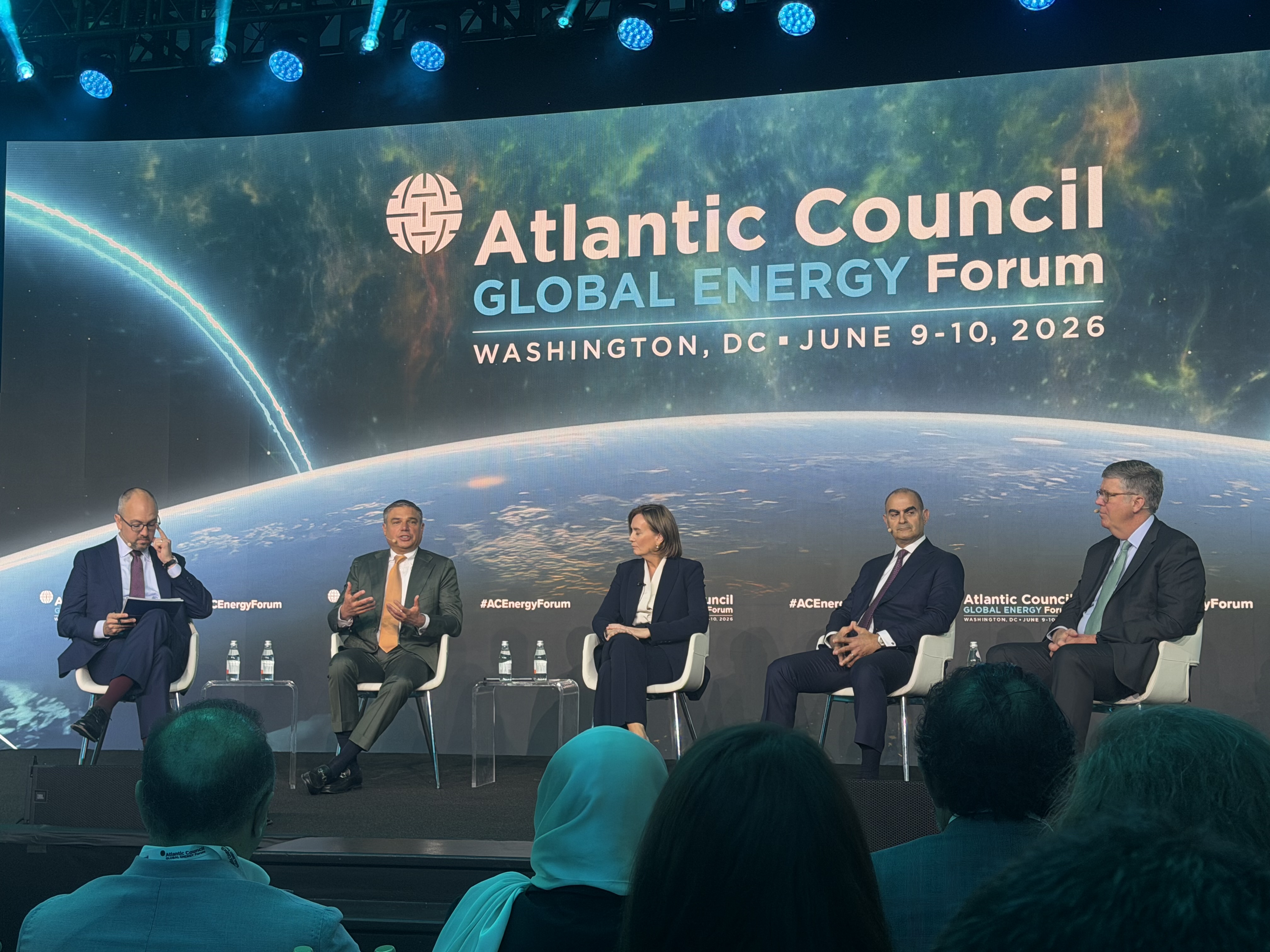
Atlantic Council GEF 2026
Executive Summary
- ›Global economic expansion is forecast to decelerate in the near term.
- ›Inflationary pressures persist, prompting central banks to maintain restrictive policies.
- ›Geopolitical tensions continue to weigh on global trade and supply chains.
- ›Emerging market economies face elevated debt vulnerabilities and capital outflow risks.
- ›The green transition presents both significant investment opportunities and policy challenges.
- ›Digitalization and AI adoption are reshaping labor markets and productivity dynamics.
What Happened
The Global Energy Forum is returning to Washington, DC, on June 9 and 10 for its tenth convening, marking a decade of dialogue and leadership in global energy policy.
The 2026 Forum will serve as both a reflection on the evolution of the global energy landscape and a forward-looking platform to chart its future based on building systems, strengthening partnerships, & empowering the public.
Economic Implications
The tenth Global Energy Forum's focus on charting the future of the global energy landscape, particularly through building systems, strengthening partnerships, and empowering the public, carries significant macroeconomic implications. From a monetary policy perspective, shifts in global energy investment and consumption patterns, potentially spurred by Forum discussions towards new energy systems, could influence inflation dynamics and central bank responses. For instance, increased capital expenditure in renewable energy infrastructure could initially create inflationary pressures through demand for raw materials and skilled labor, but eventually lead to disinflationary effects as energy costs stabilize or decline over the long term. Fiscal policy will be central to this transition, as governments are likely to play a substantial role in incentivizing research and development, subsidizing nascent technologies, and financing critical energy infrastructure. The fiscal space of emerging markets, in particular, may be constrained, requiring innovative financing mechanisms and potentially leading to increased reliance on multilateral development banks and private sector partnerships.
From a trade and capital flows perspective, efforts to strengthen international energy partnerships and build resilient systems are likely to reshape global supply chains and investment patterns. Increased cross-border investment in renewable energy technologies, critical minerals, and smart grid solutions could lead to substantial capital flows into countries with abundant natural resources and supportive policy environments. This may alter trade balances, creating new export opportunities for technologically advanced economies and resource-rich developing nations, while potentially reducing import dependence on traditional fossil fuel exporters. Sovereign credit dynamics in emerging markets are particularly sensitive to these shifts. Countries heavily reliant on fossil fuel exports may face fiscal pressures and credit downgrades if global demand for these resources declines more rapidly than anticipated. Conversely, emerging markets that successfully transition to a green energy economy or become key suppliers in the new energy ecosystem could see improved sovereign credit ratings and enhanced access to international capital markets, facilitated by a greater appetite for sustainable investments. The second-order effects on emerging markets could be profound, encompassing shifts in employment patterns, regional economic development, and even political stability as the benefits and challenges of the energy transition are unevenly distributed.
Policy Perspective
Analyst Commentary
The following is an analytical summary of discussions from a recent conference, focusing on energy evolution, future decision-making, and strategic challenges.
I. Evolution of Energy and Future Decision-Making
The initial panel discussion focused on strategic energy infrastructure development and future energy provision. Key participants included Eimear P. Bonner, Philip Haddad, Lorenzo Simonelli, John O'Brien, and Landon Derentz. The incorporation of artificial intelligence (AI) in decision-making processes, specifically for price analysis, trend identification, and cost management, was a central theme.
Agility through Geo-Diversification: Chevron's operational strategy was presented as an illustration of enhancing agility through geographical diversification of its energy portfolio and integrating AI across its operations.
Scale of US Energy Infrastructure: The United States was identified as hosting the world’s largest liquefied natural gas (LNG) facility in Rio Grande, a project involving over 3,000 personnel and an $80 billion investment by ADNOC and XRG.
Long-Term Vision: The discussion emphasized a 50-year strategic vision, underscoring legacy considerations and responsible sourcing in energy provision.
II. America at 250 – Forging an Energy Nation
A subsequent fireside chat, featuring The Hon. Kyle Haustveit, Mike Sommers, and Tala Goudarzi, analyzed the United States' role as a prominent energy producer and its implications for energy security.
Energy Security and Production Leadership: The discussion explored the ramifications of the United States' position as the foremost energy producer on global energy security.
AI in Resource Discovery: The application of AI to advance subsurface exploration techniques for improved efficiency in energy discovery was highlighted.
Energy Transition and Innovation: Deliberations encompassed Net Zero targets for 2050 and the potential contributions of agricultural, industrial nuclear, geothermal energy, and further AI integration in the energy sector.
III. Energy Leadership in a New Era of Competition
This panel, comprising Jarrod Agen, Hunter Hunt, Maxim Kolupaev, Toby Rice, and Amb. Paula J. Dobriansky, examined energy leadership within a dynamic competitive environment. The discussion focused on the influence of energy on strategic decisions by governments and corporations in managing utilities, protecting strategic interests, and identifying novel opportunities.
Jarrod Agen defined US energy dominance as its position as a leading global producer and exporter of oil and natural gas. This status was attributed to regulatory streamlining and the development of domestic resources in regions such as Alaska, the Gulf of Mexico, the Permian Basin, and the Marcellus Shale. Agen highlighted global demand for US energy, particularly from Asian and European markets, and stressed the necessity of a diversified energy mix, including oil, gas, coal, and nuclear power, to address rising demand, notably from data centers and AI. He advocated for reduced regulatory burdens to stimulate domestic energy production and exports.
Toby Rice differentiated energy dominance from energy independence, asserting that dominance correlates with maintaining competitive energy prices for US consumers and ensuring a reliable domestic energy supply. Rice identified benefits including enabling large-scale industrial development in the US, facilitating AI sector growth, and bolstering global energy security through LNG exports. He noted the substantial increase in US LNG exports, from zero in 2016 to over 20 billion cubic feet per day, with projected further growth. Rice also linked energy dominance to geopolitical stability, arguing it mitigates the capacity of certain states to leverage energy supplies politically. He concluded that increased global energy production across all forms is critical for wealth generation, poverty reduction, and achieving a five-fold increase in global GDP.
Maxim Kolupaev addressed the impact of geopolitical shocks, sanctions, supply disruptions, and market volatility on global energy flows, emphasizing that energy is a non-discretionary necessity. Given current supply constraints and high energy costs, market equilibrium is substantially achieved through demand destruction. Kolupaev observed that individual market participants’ risk and cost management efforts are insufficient to moderate price volatility. He underscored the critical requirement for short-term energy supply in the prevailing geopolitical context. Representing Glencore, he highlighted the role of liquid product provision in sustaining global energy balance over the past decade.
Hunter Hunt presented the Texas energy model as a case study for national energy dominance and reliability. He highlighted Texas's significant oil and gas production, alongside its substantial renewable energy capacity, with approximately 30 GW of wind, 39 GW of solar power, and over 20 GW of battery storage integrated into its electrical grid. Hunt emphasized that this diverse energy mix operates without state subsidies, driven by market forces. He noted Texas’s capacity to meet increasing energy demands resulting from manufacturing repatriation, AI data centers, and energy exports, citing the state’s favorable business environment.
Regarding strategic competition, Hunt stressed the importance of US companies and technology in international energy markets, particularly in regions with growing energy demand. He articulated that US operators, known for adopting rigorous standards and environmental responsibility, are preferred partners in ameliorating underinvested energy assets globally, especially in competition with entities from countries such as China and Russia. Hunt detailed how US government agencies, including the Development Finance Corporation (DFC), Export-Import Bank (EXIM), and the Department of Energy’s Dominance Council, support these international ventures. He specifically referenced initiatives in Venezuela aimed at stabilizing oil flows and facilitating new investments across various sectors, including critical minerals, mining, and electrical grid modernization.
Hunter Hunt further elaborated on the interdependency between AI and energy, noting that AI is stimulating new energy demand and intensifying competition. He observed that while the US leads in AI models and advanced chips, its energy infrastructure development lags behind nations like China, which has rapidly expanded its power generation capacity, including 40 nuclear plants currently under construction. Hunt advocated for regulatory reform to accelerate energy infrastructure development, emphasizing that a proactive approach to energy supply is crucial for maintaining global AI leadership and US competitiveness.
Jared Agen corroborated Hunt's observations concerning the urgent need for infrastructure development, citing the apparent paradox of difficulties in constructing pipelines between Pennsylvania and Massachusetts despite European reliance on US gas. He criticized regulatory impediments hindering domestic energy projects, arguing that such policies compromise energy affordability and national strategic interests.
IV. Affordability and the Energy Demand Surge – Managing Costs in a Volatile System
The final panel, comprising The Hon. Alex Fitzsimmons, Tim Holt, Josh Parker, Bonnie Titone, and Sherri Goodman, addressed challenges pertaining to energy affordability and demand surge within a volatile energy ecosystem.
Alex Fitzsimmons underscored the criticality of reliable and affordable energy. He highlighted that escalating energy demand, infrastructure costs, commodity volatility, and political sensitivities regarding consumer prices exacerbate sector challenges. Fitzsimmons asserted that a non-partisan grid operator characterized the current power system as a "five-alarm fire," attributing this to the premature retirement of reliable dispatchable generation at a rate of tens of gigawatts annually. He contrasted the historical 0.5% compound annual growth rate of power demand with current rates, which are 5 to 10 times higher, driven by the imperative to industrialize the US economy and achieve AI leadership at minimal cost to the American populace. He critically assessed previous administrations' energy policies, describing them as creating an "unacceptable position," which the current administration is actively working to reverse through "rapid replacement" of the former "energy subtraction agenda."
Tim Holt advocated for a systems approach to energy planning, promoting optimized solutions across the entire energy infrastructure rather than fragmented project development. He noted a pervasive lack of standardization in critical components, such as transformers, suggesting that industrializing the energy sector and standardizing equipment are essential for increasing capacity while maintaining affordability. Holt underscored the need for collaborative efforts to achieve these objectives within ambitious timelines.
Josh Parker discussed the significant opportunity in optimizing existing energy infrastructure through smart grid technologies. He proposed that leveraging demand flexibility could unlock tens of gigawatts of currently unused capacity. Parker highlighted Nvidia’s “DC Flex” initiative, which enables data centers to absorb surplus electricity during periods of low demand and curtail usage when the grid is strained, thereby enhancing grid stability and affordability. He explained how AI can serve as a potent solution for optimizing energy use, potentially acting as a "virtual AI power plant" that orchestrates various energy components—from battery charging to variable generation and demand—to foster a more intelligent and efficient grid. This approach aims to reduce the "AI footprint" by optimizing existing infrastructure rather than solely relying on new capacity expansion.
Bonnie Titone shared insights into Duke Energy’s strategy for delivering reliable and affordable power to its customers. She emphasized the importance of proactive engagement with communities to build trust and ensure alignment on infrastructure development. Titone explained that Duke Energy focuses on customer demands and needs, aiming for mutually beneficial solutions that secure long-term support for energy projects. She cited the company’s efforts to modernize and expand its infrastructure while maintaining affordability, noting that Duke’s rates remain below the industry average due to strategic planning and leveraging tax credits for solar and nuclear energy.
Alex Fitzsimmons detailed his role in implementing the Department of Energy’s "dominance strategy" to foster a more affordable, reliable, and secure energy system. He highlighted the department's position as the largest energy lender in the US, with approximately $250 billion in lending authority through the Office of Energy Dominance Financing. This office provides low-cost capital and champions policies to protect residential ratepayers from the costs of new energy infrastructure. Fitzsimmons referred to the “Ratepayer Protection Pledge” signed by major technology companies, which mandates that these companies either generate or purchase their own power, cover network upgrade costs, enter long-term take-or-pay agreements with minimum demand charges, and increase local community investments. He cited a $26.5 billion loan package to Georgia Power and Alabama Power—the largest federal loan package outside of a financial crisis—as an example. This package supports nuclear operations, new gas generation, battery storage, hydropower upgrades, and transmission improvements, resulting in $7 billion in interest rate savings passed directly to ratepayers via multi-year rate freezes and reductions. This model aims to accommodate increased energy demand and load growth nationwide while improving affordability.
Discussion (0)